How to open a workshop with a live question instead of an agenda slide
Replace static agenda slides with an anonymous diagnostic question to establish session expectations and build a working group contract.
· 5 min read · Fiona

Reading an agenda aloud for the first five minutes tells participants they are spectators. They sit back, check notifications, and wait to be spoken to. By the time you finish listing six bullet points of what will happen by noon, you have established the one dynamic you cannot afford in a training session: you talk, they listen.
Open instead with a diagnostic question before anyone reads an itinerary. When the first thing in the room is a shared prompt on the projector and an entry link, participants move straight into the content. You learn where their focus sits, and the incoming pattern gives you permission to negotiate how the next three hours will work.
Ask for the obstacle, not the mood
Icebreakers fail corporate sessions when they ask questions with zero operational relevance. Asking twenty senior managers which animal represents their morning energy yields eye-rolls from the skeptics and polite compliance from everyone else. It builds no credibility for the facilitator.
Replace emotional check-ins with an anonymous diagnostic. Pick one friction point central to the workshop topic and put it on screen while people are finding their chairs:
- Project delivery: "What has stalled your team's launch schedule the most this quarter?"
- Leadership development: "One habit you see senior leaders praise in public but ignore in private."
- Change management: "What is the main reason this process update will fail in your unit?"
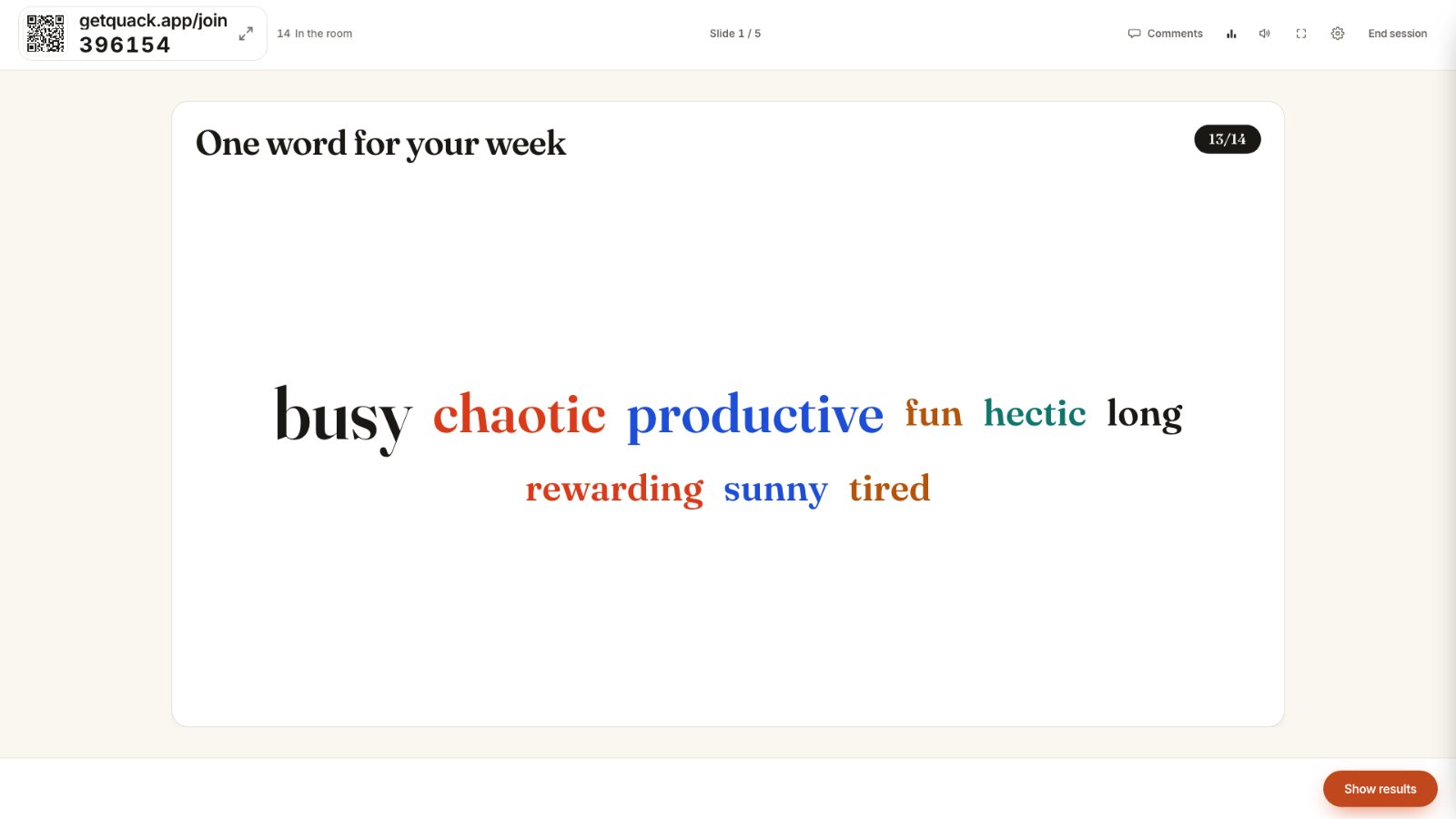
A word cloud works cleanly for this opening prompt because repeated terms grow larger on screen as people submit them. Seeing common blockers appear without names attached strips out corporate caution. When eight people in a room of fifteen enter variations of "approvals" or "unclear owners", the room collectively acknowledges the real problem before you have introduced slide one.
For more prompt patterns that cut through polite silence, read questions that get honest answers.
Let the code sit while people sit down
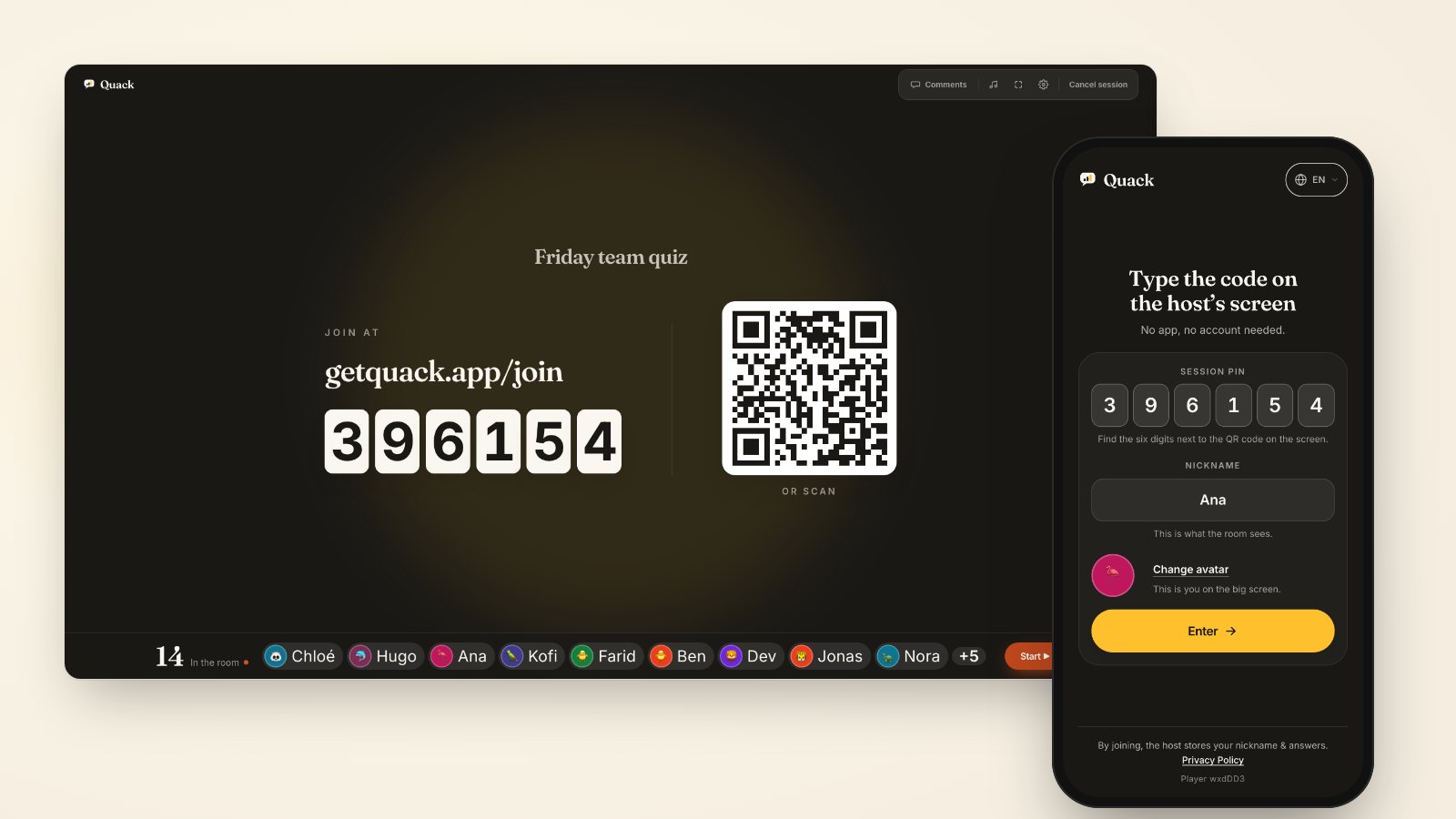
Never wait until every person is seated with an open notebook to reveal the join information. When you launch the deck on your computer, select Big screen and phones and open the lobby immediately. The join link, six-digit PIN, and QR code appear across the projector. Scanning the QR code puts the PIN straight into their phone browser, so they only need to type a nickname to join.
If you want to move away from your laptop, press Phone remote in the toolbar once the lobby is open. Scan the host QR code with your own phone camera to pair it. Your phone now displays your speaker notes and the main advance button, leaving you free to walk the floor while participants settle.
As each person walks into the room, your opening sentence is procedural rather than conversational: "Scan the code on screen, type a nickname, and put one word into the prompt before you grab coffee." Latecomers will still see the PIN and a small QR code in the top left corner of every slide once you begin. They can join mid-session without interrupting the flow.
Read the distribution aloud before setting expectations
When you open the prompt to responses, leave the slide open for roughly forty-five to sixty seconds. Look at the participant counter on the big screen. When fourteen of sixteen people have answered, close the prompt and read what arrived.
Do not jump straight into evaluating the answers. State the factual pattern first:
- Point out the largest clusters without attributing motives: "Half the submissions point to cross-team handoffs, while four people named budget approvals."
- Acknowledge outliers without interrogating who typed them: "One person wrote 'internal politics'. That usually means previous retrospectives went nowhere."
- Tie the distribution directly to the working contract of the room: "We have three hours scheduled for process mapping today. If we do not address these cross-team handoffs, mapping the process is a waste of time. Let's adjust module two to focus on handover criteria."
This simple adjustment transforms the agenda from an arbitrary syllabus into a direct solution for the room's stated problems. You are not asking for their agreement on the agenda; you are demonstrating that the time will address the exact words sitting on the wall.
For advice on handling single, sharp responses on a live display, review how to talk through a live chart without embarrassing your outliers.
Use a rating scale to calibrate experience
If the workshop is technical training or skills-based, swap the word cloud for an anonymous rating scale slide. Place a scale from 1 to 10 on the big screen: "How confident are you explaining our updated data compliance rules to an external auditor tomorrow morning?" Set the low end to "Completely lost" and the high end to "Ready today."
In most corporate sessions, the responses reveal a split group. Five people will sit at 2, while four will sit at 8.
If you ignore that spread and present standard introductory slides, the 8s tune out from boredom within ten minutes, while the 2s stay quiet because they assume everyone else already knows the material. Once the rating scale shows the spread, address both groups explicitly:
"We have several people who could run this process today, and several people who have never opened the documentation. If you scored yourself below a 4, your role today is to ask every clarification question out loud. If you scored yourself above a 7, your role during the table exercises is to test the edge cases, not just finish the basic worksheet."
This turns the diagnostic into an explicit working agreement. The room knows why some tables move faster, and no one feels defective for needing the fundamentals.
For more methods on pacing based on immediate room data, see formative questions that change the next ten minutes.
Contract the ground rules through a live poll
Instead of reading a list of behavioral ground rules like "be present" and "respect all opinions", run a quick multiple-choice poll with Allow multiple turned on. List four real operational tensions common to workshops:
- Laptops closed during discussions, open during lab work
- Hard stop at 11:30 regardless of where the conversation sits
- Call out vague jargon immediately
- Divergent ideas parked on the back whiteboard, not debated for 20 minutes
Ask the room to pick the two constraints they care about most. Give them thirty seconds to tap their screens. The live bar chart will rank their selections instantly.
When the top two choices are confirmed by their own votes, you no longer have to police the room as an external authority. If someone opens an email thread mid-discussion, you are not enforcing your own personal preference; you are holding them to the contract the group selected at 9:02 AM.
Before your next training session, delete your opening "About this session" bullet list. Replace it with a single Quack slide asking the room to name the single biggest constraint on their team today. Present it, let the code sit on the wall as people arrive, and use their first fourteen answers to define how the rest of the morning runs.