How to talk through a live chart without embarrassing your outliers
How to narrate live poll and quiz distributions on screen without dismissing minority votes, isolating outliers, or stalling your workshop agenda.
· 5 min read · Fiona

A live distribution chart reveals uncomfortable truths faster than an open room discussion. When twenty people vote on a timeline, a policy change, or a tricky technical choice, the graph rarely shows neat consensus. In a group of twenty, you will often see sixteen people cluster around option B, three pick C, and exactly one person choose option A.
Most presenters mishandle that single vote immediately. They laugh, ask "Who voted for A?", or declare that "the room has spoken" and advance the deck. The first approach puts a colleague on the spot; the second teaches the room that minority opinions do not count. When people expect either reaction, they stop voting honestly and copy whatever seems safe.
Here is how to read a live distribution chart so that outliers add depth to your session rather than anxiety.
Let the room absorb the spread before you speak
When a bar chart or poll result appears, silence is your best tool. Audiences need three to five seconds to parse the axes, match the colours to the options, and find where their own vote landed. If you start talking the millisecond the bars animate, people listen to your voice instead of looking at the data.
Take five seconds. Look at the numbers yourself. This brief pause prevents you from blurting out an unhelpful filler observation like "Looks like we have some disagreement here."
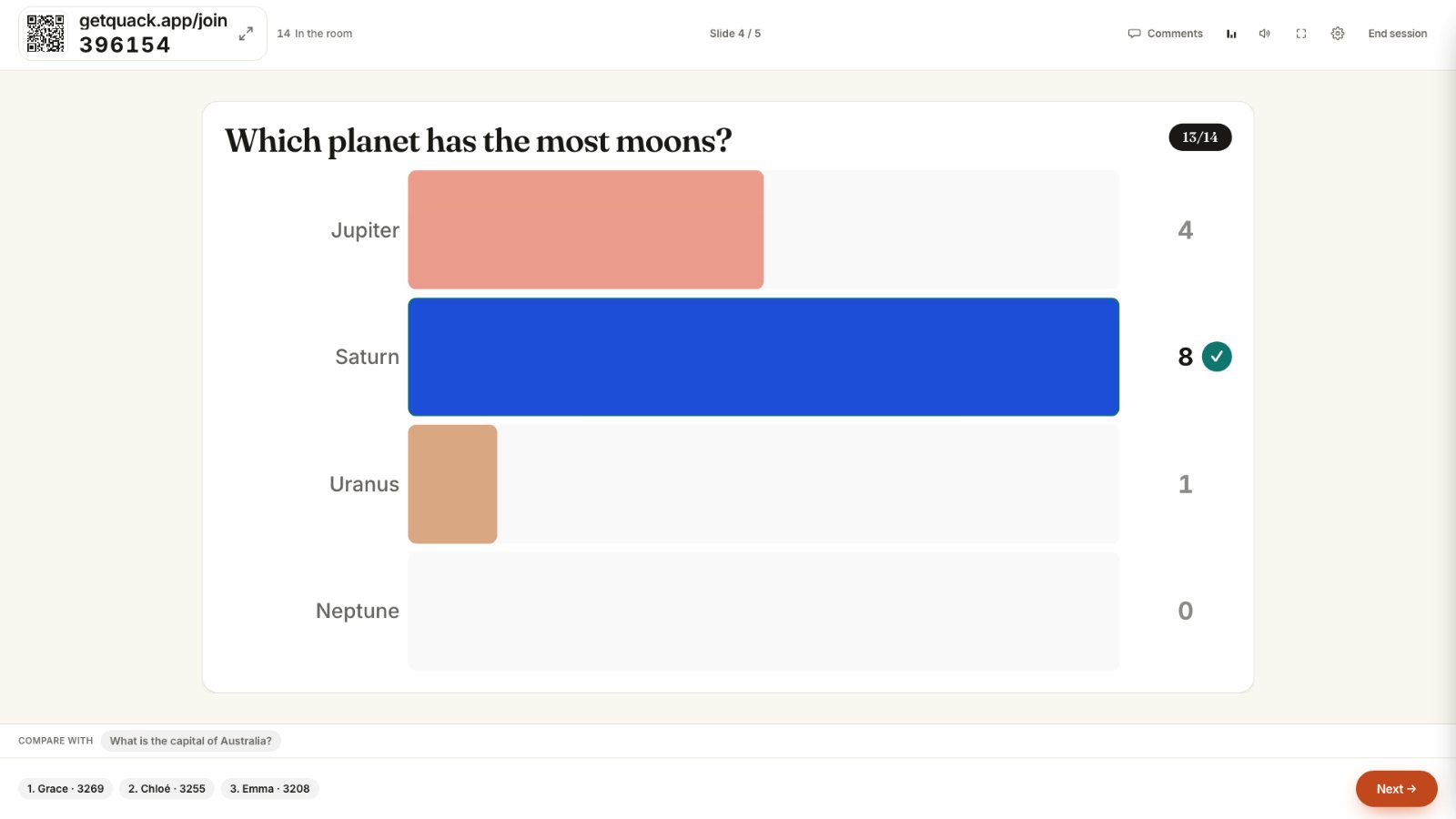
During this pause, look for two details:
- The cluster. Which option holds the centre of gravity? If fourteen people picked one bar, that is the prevailing assumption in the room.
- The spread. Are the non-majority votes spread across every remaining choice, or grouped around one plausible alternative? A three-way tie means confusion, while a single outlier on an extreme choice usually means a different operating context.
Once you have that mental snapshot, open your commentary by describing the full shape of the chart rather than crowning the winner.
State the distribution before naming the popular choice
Avoid starting with "Most of you picked B." That phrasing frames the majority as the only data point that matters and immediately isolates anyone who voted elsewhere.
Instead, describe the range: "We have votes across three different options here, with a heavy cluster on option B and a few people seeing it differently in A and C." This neutral summary legitimises the fact that alternative views exist in the room.
This matters especially when using interactive formats for diagnostic checks. In formative questions that change the next ten minutes, seeing two people pick a misunderstood concept is your signal to clarify a term, not a reason to congratulate the majority. When presenting opinion formats such as rating scales, allocate-points, or 2x2 grids, the presence of an outlier shows that your prompt successfully bypassed polite corporate agreement. For the mechanics of designing prompts that avoid false consensus, see why average scores hide disagreement.
Defend the minority vote yourself instead of hunting for who cast it
Never ask an outlier to identify themselves. Asking "Who picked option A? Can you explain why?" forces someone to defend an unpopular stance in front of peers, managers, or clients. Even confident participants often freeze or offer a self-deprecating excuse to defuse the attention.
If you want the room to understand why someone chose the lone bar, supply the rationale yourself:
- "Option A usually looks like the right path if you are managing legacy systems where automated deployments are not set up yet."
- "If you voted for the three-month delivery target in option A, you are probably factoring in the vendor contract delay we discussed yesterday."
- "There is a strong reason to pick option C here if your primary priority is data privacy rather than user onboarding speed."
By stating a plausible, respectable reason for the minority answer, you protect the outlier's psychological safety. You also teach the majority something they might have overlooked. If the person who actually voted for option A wants to speak, they will often volunteer: "Yes, that was me, and the vendor issue is exactly why I picked it." Giving them the exit ramp allows them to step forward voluntarily rather than being dragged into the spotlight.
Frame the popular wrong answer as an instructive trap
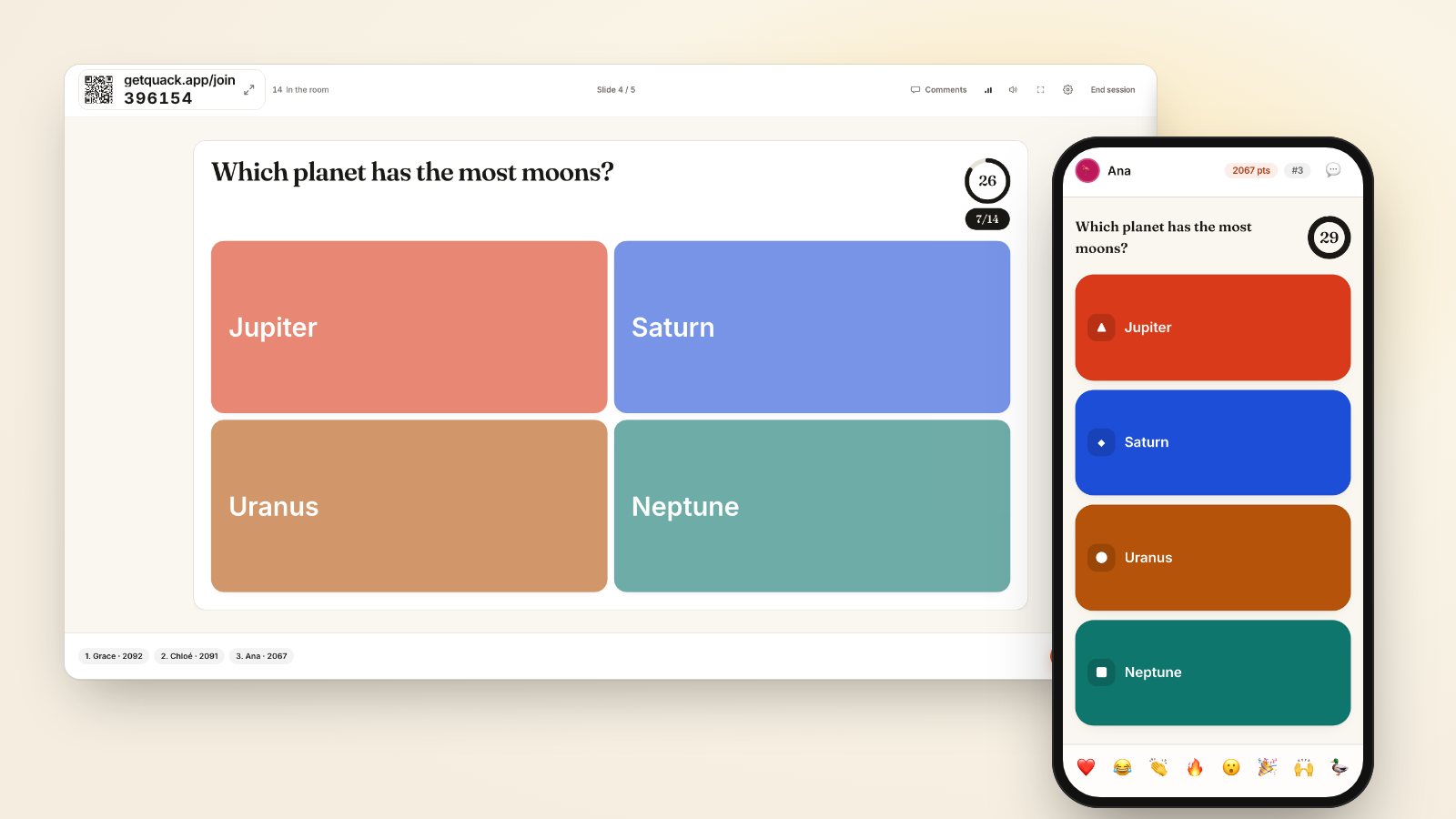
In scored quizzes, multiple-choice questions often contain a distractor that attracts a cluster of wrong answers. When you press reveal and see nine correct answers alongside seven votes for a specific wrong choice, do not treat the seven as failures.
A question that splits the room 50/50 is rarely a failure of your audience; it is proof of an instructive distractor. As explored in quiz questions that split the room, high-value wrong options teach more than easy questions everyone answers correctly.
When narrating this reveal, address the distractor directly: "Seven people picked Jupiter. That makes complete sense because Jupiter held the record for decades and has the most famous moons, but Saturn passed it once newer telescopic surveys detected smaller orbits."
By showing why the wrong answer was seductive, you remove embarrassment from those seven players and fix the misconception for the whole room in fifteen seconds.
Keep to a thirty-second budget so the agenda stays on time
Live charts can easily hijack a meeting. When an unexpected split appears, an inexperienced facilitator might spend twelve minutes debating the distribution, destroying the deck's pacing.
Use a strict three-beat script that takes thirty seconds:
- Acknowledge the spread (5 seconds): "We have twelve votes on the immediate rollout, four on a phased release, and one person voting to pause entirely."
- Validate the outlier (15 seconds): "Pausing sounds radical compared to the room's momentum, but if compliance sign-off is pending, pausing is the only legal move."
- Decide the next action (10 seconds): "Because twelve of us assume we are clear to proceed, I will confirm the compliance status by noon before we execute." Then advance to the next slide.
By defining what the data means for the next action, you close the discussion cleanly without leaving loose threads or stalled slides.
In your next session, pick one slide where you anticipate disagreement. Commit to stating the rationale for the least popular answer yourself before inviting any comments from the room.